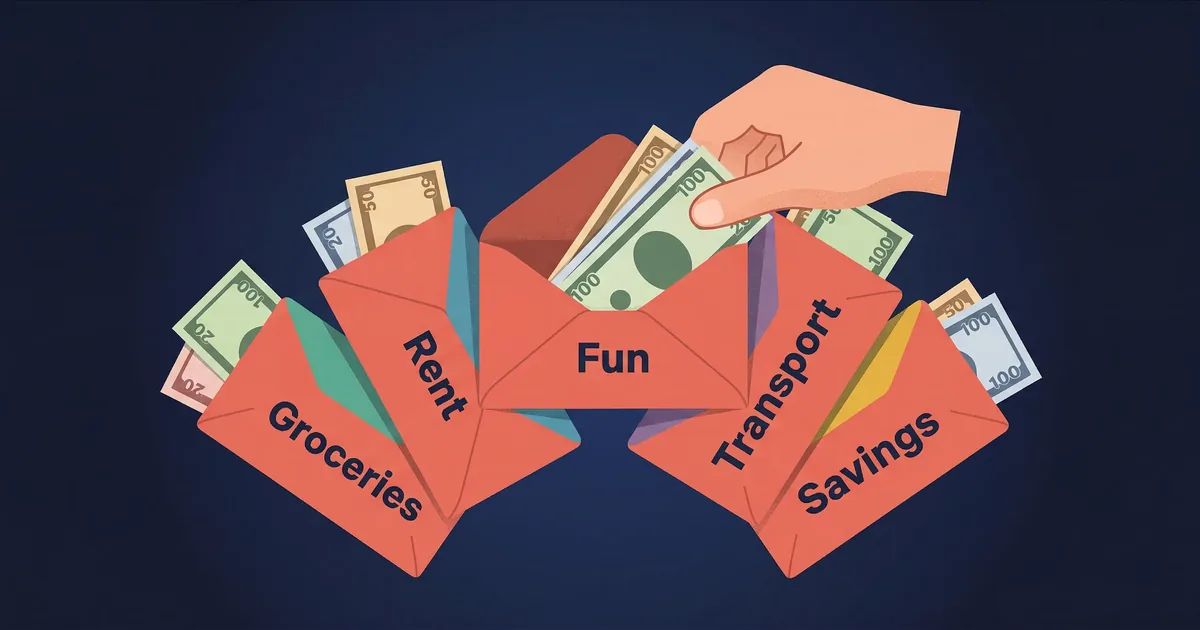
Before budgeting apps existed, people controlled their spending with a brilliantly simple system: cash envelopes. You take your monthly spending money in cash, divide it into labeled envelopes for each category, and when an envelope is empty, you stop spending. No tracking, no spreadsheets, no willpower required — the empty envelope stops you.
The envelope method is still one of the best budgeting methods, especially for people who tend to overspend with debit and credit cards. In this guide we will explain how to set it up, which categories to use, and how to use it in a digital world.
What Is the Envelope Budgeting System?
The envelope system is a cash-based budgeting method where you physically divide your spending money into labeled envelopes. Each envelope represents a budget category with a set spending limit for the month.
The psychology is powerful. Research from MIT shows that paying with cash feels more painful to your brain than swiping a card. You literally feel the money leaving, which makes you spend more carefully.
How to Set Up Cash Envelopes
Step 1: Identify Variable Spending Categories
Envelopes work best for variable expenses — categories where spending changes and you tend to overspend. Fixed bills like rent, insurance, and loan payments should stay on autopay. Understanding the difference between needs and wants helps you pick the right categories.
Step 2: Set Monthly Limits for Each Envelope
Review your past 2–3 months of spending to find realistic limits. Do not set them too tight at first — that leads to frustration and quitting. You can tighten limits over time.
Step 3: Withdraw Cash on Payday
On payday, go to the bank (or ATM) and withdraw the total amount needed for all your envelopes. If your envelopes total $1,200 for the month, withdraw that amount in bills that are easy to split up.
Step 4: Fill Your Envelopes
Divide the cash into each labeled envelope according to your planned amounts. Some people fill all envelopes at once; others fill weekly to maintain better control.
Step 5: Spend Only From Envelopes
When you buy groceries, take cash from the grocery envelope. When you dine out, use the dining envelope. When the envelope is empty, that category is done for the month.
Best Categories for Envelope Budgeting
| Envelope | Suggested Amount | Notes |
|---|---|---|
| Groceries | $300–$500 | Biggest variable expense for most households |
| Dining Out | $100–$250 | Restaurants, coffee, takeout |
| Entertainment | $50–$150 | Movies, events, hobbies |
| Clothing | $50–$100 | Can roll unused balance to next month |
| Personal Care | $30–$75 | Haircuts, toiletries, cosmetics |
| Household | $25–$75 | Cleaning supplies, small home items |
| Fun Money | $50–$100 | Per person, no-judgment spending |
| Gifts | $25–$50 | Accumulate for birthdays and holidays |
Digital Envelope Budgeting
Carrying cash is not practical for everyone. The good news: the envelope concept works just as well digitally. Instead of physical envelopes, you create budget categories in an app with set spending limits.
Budgeting365 functions as a digital envelope system. You create categories (your virtual envelopes), set monthly limits, and log transactions against each category. Visual progress rings show you exactly how much remains in each “envelope” at a glance.
The digital approach offers advantages over physical cash:
- Works with cards, online shopping, and mobile payments
- Automatically tracks your remaining balance per category
- Historical data helps you set better limits over time
- No risk of losing cash
- Easy to share with a partner
Pros and Cons
Advantages
- Forces spending awareness: Physically handing over cash makes you think more carefully
- Simple to understand: No apps, spreadsheets, or complicated formulas
- Built-in stop mechanism: Empty envelope = stop spending
- Great for overspenders: Having limited cash stops impulse buying
Disadvantages
- Inconvenient for online shopping: You need a digital alternative
- Security risk: Carrying large amounts of cash can be risky
- No purchase protection: Cash purchases do not have credit card protections
- Trips to the bank: Requires regular cash withdrawals
Try Digital Envelope Budgeting
Create virtual envelopes with spending limits, track every transaction, and see progress rings that show exactly how much remains in each category.
Download Budgeting365 — FreeFrequently Asked Questions
How does the envelope budgeting system work?
You withdraw your monthly spending money in cash and divide it into labeled envelopes for each category. When an envelope is empty, you stop spending in that category until next month.
What categories should I use?
Start with variable spending categories where you tend to overspend: groceries, dining out, entertainment, clothing, personal care, and household items. Keep fixed bills on autopay.
Can I do envelope budgeting without cash?
Yes. Digital envelope budgeting uses an app to create virtual envelopes with set limits. Apps like Budgeting365 work as digital envelope systems with visual progress tracking.
What if I run out of money in an envelope?
Either stop spending in that category or borrow from another envelope (meaning that category has less). The discipline of seeing limited cash is what makes the system effective.
Is envelope budgeting good for couples?
Yes. It creates clear spending boundaries both partners can see and agree on. Budgeting as a couple works especially well with envelopes since each person can carry personal spending envelopes while sharing household envelopes.