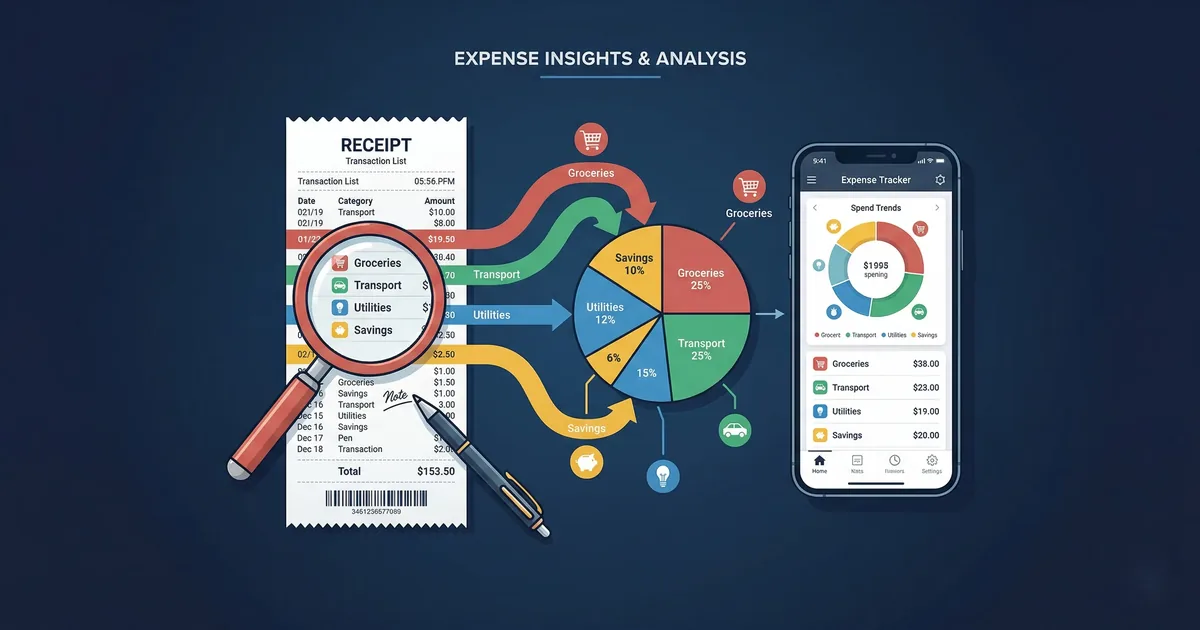
If you do not track your money, you cannot control it. Research from the Consumer Financial Protection Bureau confirms that people who track their spending save 10–15% more. Why? Because knowing where your money goes changes how you spend.
Why Track Expenses?
- Find the leaks: Most people have $200–$400/month in spending they do not realize — often a gap between needs and wants.
- Make informed decisions: Real data beats guessing when cutting costs.
- Stay on budget: Tracking shows you in real-time how much you have left in each category.
- Spot trends: Notice seasonal patterns, slowly rising lifestyle inflation, or categories growing over time. This insight is key to reducing your monthly bills.
6 Tracking Methods Compared
| Method | Best For | Effort | Cost |
|---|---|---|---|
| Budgeting App | Most people | Low | Free–$10/mo |
| Spreadsheet | Data lovers | Medium | Free |
| Pen & Paper | Tangible learners | High | Free |
| Bank Statement Review | Minimal effort | Low | Free |
| Envelope System | Cash spenders | Medium | Free |
| Receipt Box | Beginners | Medium | Free |
1. Budgeting App (Recommended)
The fastest and most convenient method. Log expenses in seconds from your phone. Get automatic categorization, charts, and spending insights. Apps like Budgeting365 work completely offline with encrypted data storage.
2. Spreadsheet
Create columns for date, description, category, and amount. Use formulas to total each category and compare to your budget. Great for people who want full customization and enjoy working with numbers.
3. Pen and Paper
Carry a small notebook and write down every purchase. At the end of the week, categorize and total. Writing by hand makes you more aware of your spending than any other method.
4. Bank Statement Review
At month-end, export your bank and credit card transactions. Categorize each one and total by category. Lowest daily effort but provides the least real-time awareness.
5. Envelope System
Withdraw cash for variable spending categories (groceries, dining, entertainment). Put cash in labeled envelopes. When an envelope is empty, that category is done for the month. Learn more in our envelope budgeting guide.
6. Receipt Box
Save every receipt in a box or envelope. At week-end, sort them by category and log totals. A simple starting point for people who have never tracked before.
Essential Expense Categories
- Housing (rent/mortgage)
- Utilities (electric, gas, water, internet)
- Groceries
- Transportation (gas, transit, car payment)
- Insurance (health, auto, home/renter)
- Healthcare (copays, prescriptions)
- Dining Out
- Entertainment & Subscriptions
- Personal Care
- Clothing
- Savings & Investments
- Miscellaneous
Building the Tracking Habit
- Log immediately: Record expenses the moment you make them, not later.
- Set a daily reminder: If you forget during the day, set a 9 PM alarm to log everything.
- Keep it simple: Start with fewer categories. You can always add detail later.
- Weekly review: Spend 10 minutes each Sunday reviewing the week's spending.
- Do not judge yourself: The first month is about gathering data, not achieving perfection. Focus on building good financial habits first.
Track Every Dollar
Budgeting365 makes expense tracking effortless with quick-entry, custom categories, and visual reports — all free and offline with AES-256 encryption.
Download Budgeting365 — FreeFrequently Asked Questions
What is the best way to track daily expenses?
A mobile app offers the best convenience — log expenses in seconds right when they happen.
How often should I track expenses?
Daily logging with weekly and monthly reviews gives you the clearest picture.
What categories should I use?
Start with 8–12 categories covering housing, food, transport, insurance, healthcare, entertainment, and savings.
Should I track cash spending?
Yes. Cash is the easiest to lose track of. Log it immediately or use a set weekly cash allowance.
How long to see results?
Spending awareness starts within 1–2 weeks. After 2–3 months, most people naturally reduce spending by 10–15%.