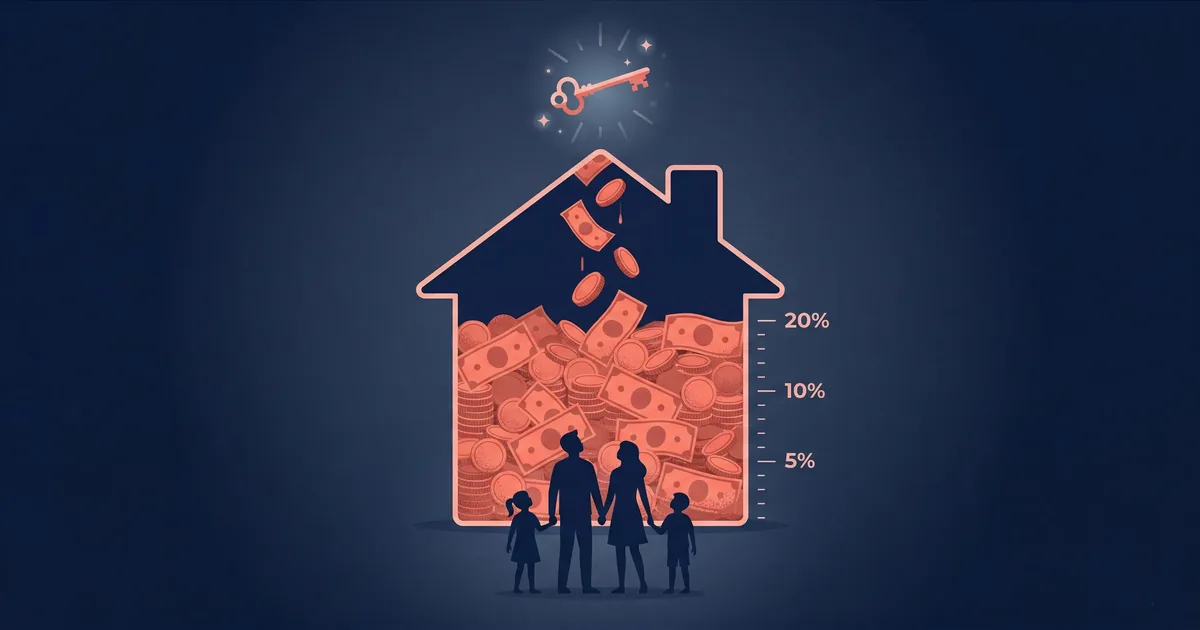
Saving for a house down payment is one of the biggest financial goals most people tackle. Whether you are aiming for 3.5% or 20%, this guide gives you a clear plan to reach your target without giving up your lifestyle.
How Much Down Payment Do You Need?
| Loan Type | Min. Down Payment | On $300K Home | PMI Required? |
|---|---|---|---|
| Conventional | 3–5% | $9,000–$15,000 | Yes (until 20% equity) |
| Conventional 20% | 20% | $60,000 | No |
| FHA | 3.5% | $10,500 | Yes (life of loan) |
| VA | 0% | $0 | No |
| USDA | 0% | $0 | Yes (reduced) |
Set Your Savings Timeline
Work backward from your goal:
- Choose your target home price.
- Decide on your down payment percentage.
- Add closing costs (3% is a safe estimate).
- Divide by the number of months until your target purchase date.
Example: $300,000 home, 10% down + 3% closing costs = $39,000 needed. Over 3 years (36 months) = $1,083/month in savings.
If that number feels too high, extend the timeline, lower your target price, or reduce your down payment percentage.
8 Strategies to Save Faster
1. Open a Dedicated Savings Account
Keep your down payment fund separate from your regular savings. A high-yield savings account earns 4–5% APY while keeping your money easy to access and FDIC protected.
2. Automate Monthly Transfers
Set up an automatic transfer on payday. Treat your down payment savings like a bill — required and automatic.
3. Cut One Major Expense
Downsize your apartment, drive a cheaper car, or cancel a large subscription. A single major cut can free up $200–$500/month.
4. Redirect Windfalls
Tax refunds, bonuses, birthday money, and rebates all go straight to the house fund. A $3,000 tax refund can cut 3 months from your timeline.
5. Start a Side Hustle
Put all side income toward your down payment. Freelancing, tutoring, selling items, or gig work can add $500–$2,000/month to your savings rate.
6. Reduce Dining Out and Subscriptions
The average household spends $325/month dining out. Cutting this in half frees up $160/month — almost $6,000 over 3 years.
7. Use Budgeting365 to Track Progress
Set your down payment as a savings goal in Budgeting365 and watch your progress bar fill up each month. Visual progress keeps you motivated.
8. Research First-Time Buyer Programs
Many states offer down payment assistance grants or forgivable loans for first-time buyers. Some programs provide 3–5% of the home price as a grant you never repay.
Where to Keep Your Down Payment Savings
| Option | Return | Risk | Best For |
|---|---|---|---|
| High-Yield Savings | 4–5% APY | None (FDIC) | Buying in 1–5 years |
| CDs | 4–5% APY | None (FDIC) | Fixed timeline, won't need early |
| Money Market | 4–5% APY | None (FDIC) | Need check-writing ability |
| I-Bonds | Inflation-adjusted | None (Treasury) | 3+ year timeline |
| Stocks/Funds | Varies | High | NOT recommended for <5 years |
Mistakes to Avoid
- Investing in stocks: A 30% market drop could delay your purchase by years.
- Draining your emergency fund: Keep 3–6 months of expenses separate.
- Ignoring closing costs: You need more than just the down payment.
- Buying too much house: A mortgage should be no more than 28% of gross income.
- Skipping pre-approval: Get pre-approved early to know your real budget.
Track Your Home Savings Goal
Set your down payment target in Budgeting365 and track every dollar toward homeownership — free and offline.
Download Budgeting365 — FreeFrequently Asked Questions
How much do I need for a down payment?
3.5% (FHA) to 20% (conventional without PMI). On a $300K home that is $10,500 to $60,000.
How long does it take to save for a down payment?
It depends on your savings rate. At $1,000/month for a $30,000 goal, it takes 2.5 years. At $500/month, 5 years.
Should I put 20% down or less?
20% avoids PMI but delays your purchase. If monthly payments are affordable with PMI, buying sooner can be worth it.
Where should I keep my down payment savings?
A high-yield savings account (4–5% APY) provides safety and liquidity. Avoid stocks for money you need within 5 years.
What are closing costs?
Fees for processing your mortgage, typically 2–5% of the home price. On $300K, expect $6,000–$15,000.