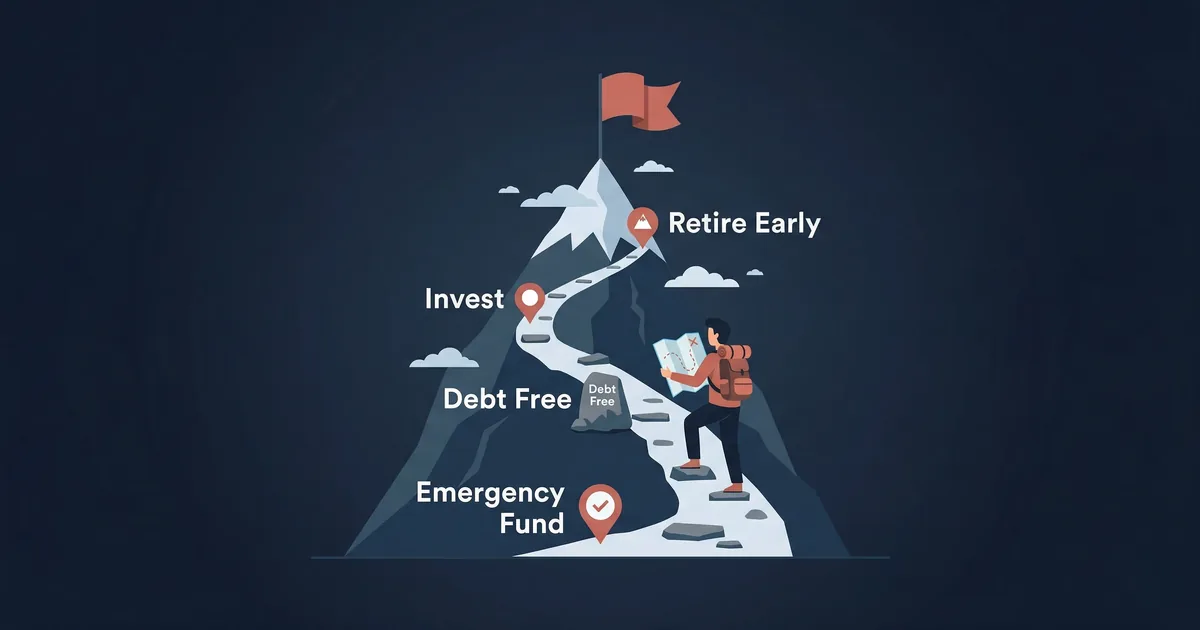
People without written financial goals save 42% less than those who write them down. A clear goal turns wishes into real plans with deadlines and numbers to track.
Why Financial Goals Matter
Goals give your money direction. Without them, extra money disappears into unplanned spending. With them, every dollar has a purpose.
- Motivation: A specific target keeps you focused when tempted to overspend.
- Measurement: You can track progress and celebrate milestones.
- Decision-making: Goals make it easy to say no to things that do not align.
- Compounding: Starting earlier gives much better results.
The SMART Framework
Every financial goal should pass the SMART test:
| Letter | Meaning | Example |
|---|---|---|
| S | Specific | Save for a 3-month emergency fund |
| M | Measurable | $9,000 total ($3,000/month expenses × 3) |
| A | Achievable | $750/month from cutting subscriptions and dining |
| R | Relevant | Protects against job loss or emergencies |
| T | Time-bound | Complete by December 2026 (12 months) |
Types of Financial Goals by Time Horizon
Short-Term Goals (Under 1 Year)
- Build a $1,000 starter emergency fund
- Pay off one credit card balance
- Save $2,000 for a vacation
- Create and follow a monthly budget for 3 consecutive months
- Build a one-month expense buffer in checking
Mid-Term Goals (1–5 Years)
- Pay off all non-mortgage debt
- Save a house down payment (10–20% of target price)
- Build a full 3–6 month emergency fund
- Save for a career change or education
- Start investing with $5,000 in an index fund
Long-Term Goals (5+ Years)
- Save $1 million for retirement
- Pay off your mortgage early
- Fund children's college education
- Achieve financial independence
- Build passive income streams
How to Prioritize Multiple Goals
When many goals compete for the same money, use this order:
- $1,000 starter emergency fund
- Employer 401(k) match (free money)
- Pay off high-interest debt (> 7% APR)
- Full emergency fund (3–6 months expenses)
- Retirement savings (15% of gross income)
- All other goals (house, college, travel, etc.)
You do not need to finish one step before starting the next. For example, contribute enough to get your full 401(k) match while building your emergency fund.
Tracking Your Progress
- Write goals down: Put them in a budgeting app, spreadsheet, or notebook.
- Break into monthly targets: Divide the total amount by the number of months.
- Automate transfers: Set up automatic transfers on payday to goal-specific accounts.
- Review monthly: Check progress at the same time you review your budget.
- Adjust as needed: Life changes. Increase, decrease, or pause goals when things change.
Track Your Financial Goals
Budgeting365 lets you create custom savings goals, track progress visually, and stay on target — all offline and free.
Download Budgeting365 — FreeFrequently Asked Questions
What are SMART financial goals?
SMART goals are Specific, Measurable, Achievable, Relevant, and Time-bound. They turn wishes into real plans you can act on.
What are examples of short-term financial goals?
Building a $1,000 emergency fund, paying off one credit card, saving for a vacation, or budgeting consistently for 3 months.
How many financial goals should I have at once?
Focus on 3–5 goals across different time ranges. This keeps you making progress without losing focus.
How do I prioritize multiple goals?
Starter emergency fund first, then employer match, high-interest debt, full emergency fund, retirement, then everything else.
Should I save or pay off debt first?
Build a $1,000 starter emergency fund, then attack high-interest debt aggressively before expanding savings.