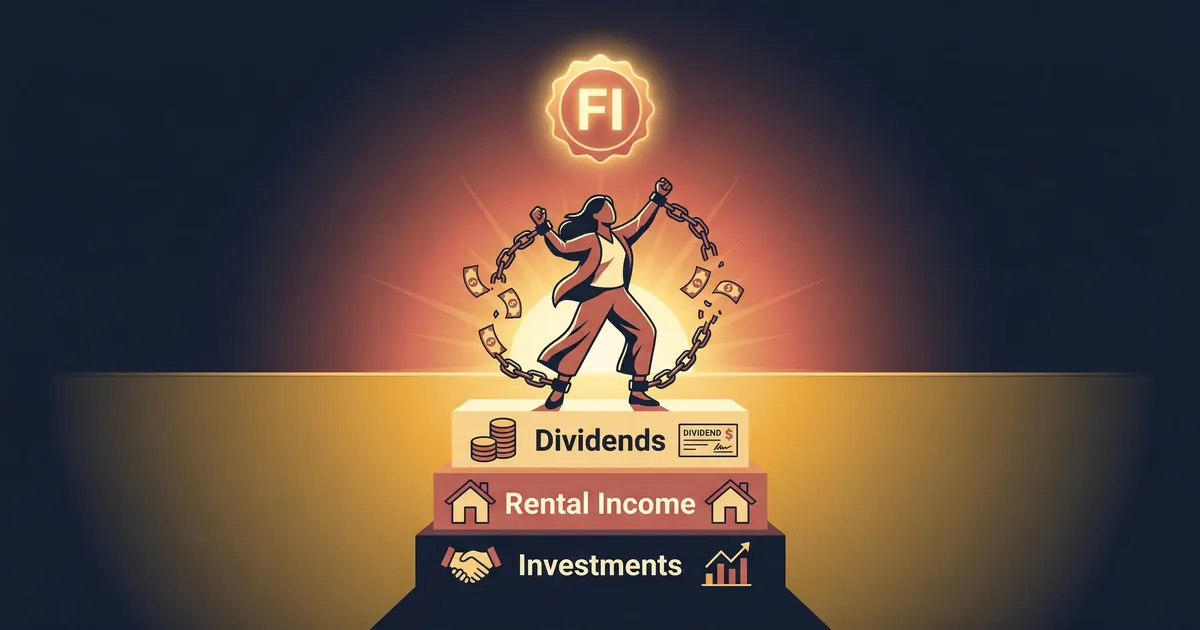
Financial independence (FI) means having enough invested wealth that your investment returns cover your living expenses — permanently. You no longer need to work for money. Whether you retire early, switch careers, or keep working by choice, FI gives you options.
What Is Financial Independence?
Calculate Your FI Number
Your FI number is based on the 4% rule (from the Trinity Study). You can safely take out 4% of your investment portfolio per year without running out of money over 30+ years.
| Annual Expenses | FI Number (25x) | Monthly Passive Income at 4% |
|---|---|---|
| $30,000 | $750,000 | $2,500 |
| $40,000 | $1,000,000 | $3,333 |
| $50,000 | $1,250,000 | $4,167 |
| $60,000 | $1,500,000 | $5,000 |
| $80,000 | $2,000,000 | $6,667 |
Key insight: Reducing expenses lowers your FI number and increases your savings rate. Cutting $500/month from expenses reduces your FI number by $150,000.
The Power of Savings Rate
Your savings rate — the percentage of take-home pay you invest — is the single biggest factor determining how fast you reach FI.
| Savings Rate | Years to FI* |
|---|---|
| 10% | 51 years |
| 20% | 37 years |
| 30% | 28 years |
| 40% | 22 years |
| 50% | 17 years |
| 60% | 12.5 years |
| 70% | 8.5 years |
*Assumes 5% real return (after inflation), starting from zero savings.
The FI Roadmap (7 Stages)
- Stage 1 — Financial Awareness: Know your income, expenses, debts, and net worth. Track everything.
- Stage 2 — Financial Stability: Build a 3–6 month emergency fund. Eliminate high-interest debt.
- Stage 3 — Debt Freedom: Pay off all consumer debt (credit cards, car loans, student loans).
- Stage 4 — Accumulation: Save as much as you can. Invest in low-cost index funds. Set up automatic transfers.
- Stage 5 — Coast FI: Your invested amount will grow to your FI number by traditional retirement age, even if you stop contributing. You only need to cover current expenses.
- Stage 6 — Financial Independence: Investments cover all expenses at 4% withdrawal rate. Work becomes optional.
- Stage 7 — Financial Abundance: More than enough. You can give freely and follow any interest.
Flavors of FIRE
| Type | Description | Annual Expenses |
|---|---|---|
| Lean FIRE | Minimal lifestyle, very low expenses | Under $40,000 |
| Regular FIRE | Comfortable middle-class lifestyle | $40,000–$80,000 |
| Fat FIRE | Luxury lifestyle without budget constraints | $100,000+ |
| Barista FIRE | Part-time work covers expenses; investments grow | Part-time income + investments |
| Coast FIRE | Stop investing; current portfolio grows to FI by 65 | Only cover current expenses |
Start Your FI Journey
Budgeting365 helps you track expenses, measure savings rate, and reach your financial independence number — all offline, free, AES-256 encrypted.
Download Budgeting365 — FreeFrequently Asked Questions
What is the FIRE movement?
FIRE (Financial Independence, Retire Early) focuses on aggressive saving and investing so investment returns cover living expenses permanently.
How do I calculate my FI number?
Multiply annual expenses by 25. Spend $40,000/year? Your FI number is $1,000,000.
How long does it take?
Depends on savings rate. 10% = 51 years, 25% = 32 years, 50% = 17 years, 70% = 8.5 years.
Do I need a high income?
No. Savings rate matters more than income. Someone saving 50% of $50K reaches FI faster than someone saving 10% of $150K.
What is the 4% rule?
Withdraw 4% of your portfolio in year one, adjust for inflation each year, and you have a 95%+ chance of not running out of money over 30 years.