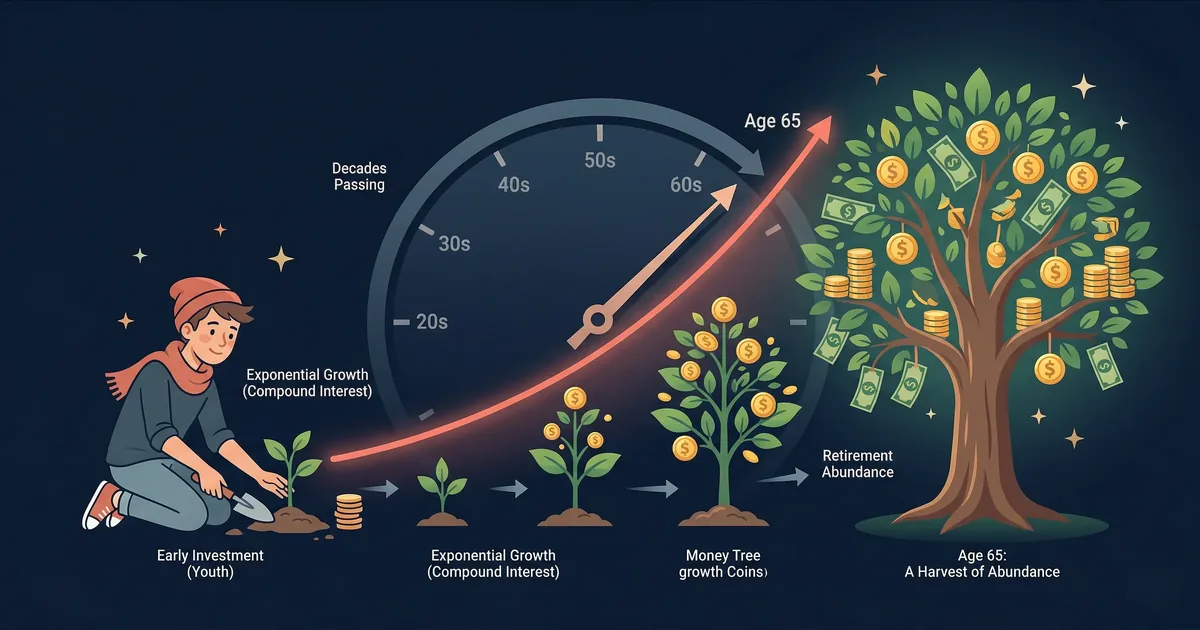
Starting retirement savings in your 20s is the single most powerful financial move you can make. Thanks to compound interest, every dollar you invest in your 20s is worth more than 10 times a dollar invested in your 50s. Time is your biggest advantage — use it.
Why Starting in Your 20s Matters
The Power of Compound Interest
| Start Age | Monthly Investment | Value at 65 (8% avg) | Total Contributed |
|---|---|---|---|
| 25 | $300 | $1,050,000 | $144,000 |
| 30 | $300 | $680,000 | $126,000 |
| 35 | $300 | $440,000 | $108,000 |
| 40 | $300 | $275,000 | $90,000 |
Retirement Account Types
401(k) / 403(b)
Employer-sponsored plans with 2025 contribution limits of $23,500/year. Many employers match your contributions up to 3–6% of salary — this is free money. Always contribute at least enough to get the full employer match.
Roth IRA
Individual account with a $7,000/year limit (2025). Contributions are after-tax, but growth and withdrawals are completely tax-free in retirement. Ideal for people in their 20s who are in a lower tax bracket.
Traditional IRA
$7,000/year limit. Contributions may be tax-deductible now, but you pay taxes on withdrawals in retirement. Best if you expect to be in a lower tax bracket when you retire.
| Feature | 401(k) | Roth IRA | Traditional IRA |
|---|---|---|---|
| 2025 Limit | $23,500 | $7,000 | $7,000 |
| Employer Match | Yes | No | No |
| Tax Now | Pre-tax | After-tax | Deductible |
| Tax in Retirement | Taxed | Tax-free | Taxed |
| Best For 20s | Get the match | Excellent | Good if high earner |
How Much Should You Save?
The target is 15% of your gross income, including any employer match. If that is too much right now, here is how to build up:
- Start with the employer match: If your company matches 3%, contribute 3%. That is 6% total going toward retirement for free.
- Open a Roth IRA: Contribute whatever you can afford, even $100/month.
- Increase by 1% per year: Each raise, increase your 401(k) contribution by 1% until you hit 15%.
Even $100/month starting at age 25, invested at 8% annual return, grows to roughly $350,000 by age 65. This is the power of compound interest. Start with what you can. Increase over time.
5 Steps to Start Saving for Retirement
Step 1: Build a Small Emergency Fund First
Save $1,000 in an emergency fund before starting retirement contributions. This prevents you from withdrawing retirement money for unexpected expenses.
Step 2: Enroll in Your Employer's 401(k)
Sign up and contribute at least enough to get the full employer match. This is an instant 50–100% return on your money.
Step 3: Open a Roth IRA
Open a Roth IRA at a low-cost brokerage. Invest in broad market index funds with expense ratios below 0.10%.
Step 4: Automate Contributions
Set up automatic transfers on payday. If you never see the money in your checking account, you will not miss it.
Step 5: Increase Annually
Every January or with each raise, increase your contribution rate by 1%. You will barely notice the difference in your paycheck, but it compounds dramatically over decades.
Common Mistakes
- Waiting to start: Every year you wait can cost you tens of thousands of dollars in lost growth.
- Not getting the employer match: This is free money you are giving up.
- Cashing out when changing jobs: Rolling your 401(k) into an IRA keeps your savings and avoids taxes and penalties.
- Being too conservative: In your 20s, you have 40+ years until retirement. Invest mostly in stocks — you have time to recover from market drops.
- Thinking you cannot afford it: Even $50/month matters. Start small and increase over time.
Budget for Your Future
Use Budgeting365 to set aside retirement savings in your monthly budget and track your progress toward financial freedom.
Download Budgeting365 — FreeFrequently Asked Questions
How much should I save for retirement in my 20s?
Aim for 15% of gross income including employer match. Start with what you can and increase by 1% each year.
Should I pay off debt or save for retirement first?
Do both. Get the full employer match (free money), then focus extra on high-interest debt, then increase retirement savings to 15%.
What is the difference between a 401(k) and an IRA?
401(k) is employer-sponsored with higher limits ($23,500) and may include matching. IRA is individual with $7,000 limits but more investment choices.
Should I choose Roth or Traditional?
In your 20s, Roth is usually better since you are in a lower tax bracket. Pay taxes now at lower rates, withdraw tax-free in retirement.
How does compound interest help retirement?
Your earnings generate their own earnings. Starting at 25 with $300/month at 8% grows to $1.05M by 65. Waiting until 35 yields only $440K.