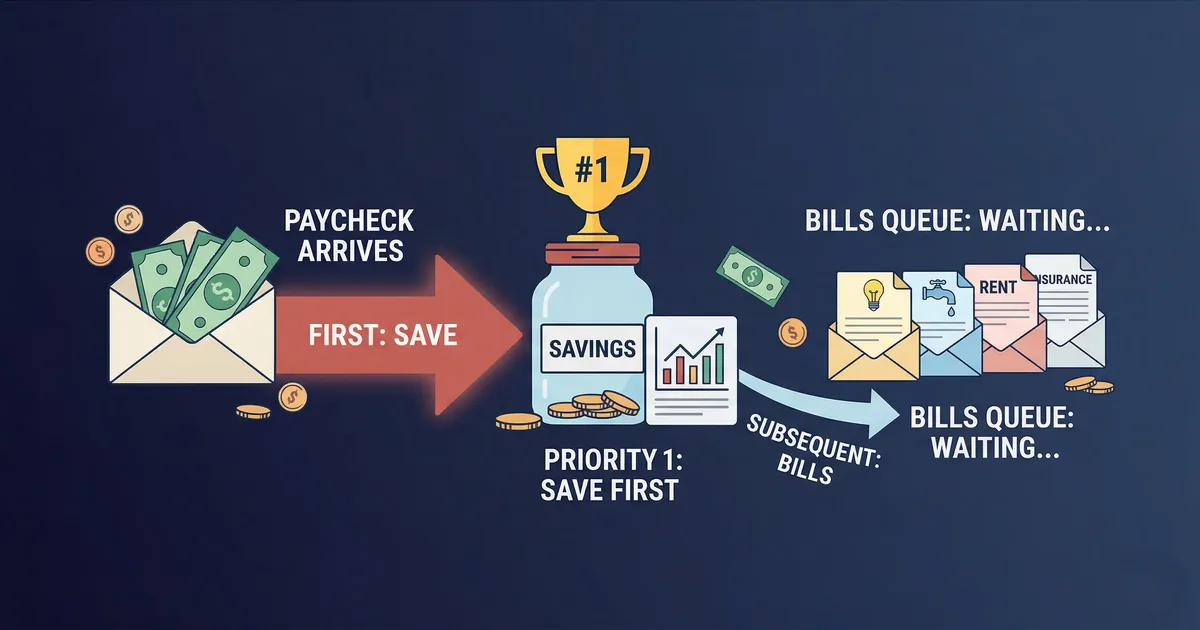
Most people budget by paying bills first, spending what they want, and saving whatever is left over. The problem? There is never anything left over. The pay yourself first strategy flips this order — and it is the most effective way to build wealth.
What “Pay Yourself First” Means
Pay yourself first: Income → Savings → Bills → Spending (what’s left)
The moment your paycheck lands, a set amount is automatically transferred to savings, retirement, and investment accounts. You never see that money in your checking account, so you learn to live on what remains.
Why It Works
- Removes willpower: Automated transfers happen whether you feel motivated or not
- Prevents lifestyle creep: You budget from a smaller number, so raises become savings, not spending
- Exploits loss aversion: Money you never see feels like money you never had
- Compound effect: Consistent early saving beats occasional large deposits thanks to compound interest
How Much Should You Pay Yourself?
| Situation | Target % | On $4,000/mo |
|---|---|---|
| Beginner / tight budget | 5–10% | $200–$400 |
| Building emergency fund | 10–15% | $400–$600 |
| Comfortable saver | 15–20% | $600–$800 |
| Aggressive wealth-builder | 25–50% | $1,000–$2,000 |
If you cannot save 5%, start with 1% — even $40 per paycheck. Build the habit first, then increase the percentage.
Step-by-Step Setup
Step 1: Calculate Your Savings Target
Decide how much to save per paycheck. Start with your net income and apply a target percentage. Example: $3,200 net × 15% = $480.
Step 2: Open Separate Accounts
Keep savings separate from checking so you are not tempted to spend it. Recommended accounts:
- High-yield savings (HYSA) — Emergency fund (earns 4–5% APY)
- 401(k) or 403(b) — Retirement (pre-tax, often with employer match)
- Roth IRA — Additional retirement (tax-free growth)
- Sinking fund HYSA — Short-term goals (vacation, car, gifts)
Step 3: Automate Transfers
Set up automatic transfers timed to your payday. Your bank or employer can split direct deposits into multiple accounts automatically.
Step 4: Budget the Remainder
Only now do you create your spending budget — using the money left after savings are removed. This is sometimes called “reverse budgeting” because savings come first.
Real Paycheck Example
| Category | Amount | % of Net |
|---|---|---|
| Net paycheck | $3,200 | 100% |
| Emergency fund (auto-transfer) | $200 | 6% |
| Roth IRA (auto-invest) | $250 | 8% |
| Sinking funds (auto-transfer) | $100 | 3% |
| Total paid to self | $550 | 17% |
| Remaining for bills & spending | $2,650 | 83% |
After one year of this schedule, you would have saved $6,600 in emergency funds, $3,000+ in retirement (with growth), and $1,200 in sinking funds. That is a total of over $10,800.
Track Your Pay-Yourself-First Budget
Budgeting365 helps you set savings goals, track progress, and manage spending — all offline, free forever, with AES-256 encryption.
Download Budgeting365 — FreeFrequently Asked Questions
How much should I pay myself first?
Aim for 20% of gross income. If that’s too much, start with 5–10% and increase by 1% each month.
Where should I put the money?
Emergency fund in a HYSA, retirement in 401(k)/IRA, short-term goals in a separate HYSA or money market account.
Is this the same as the 50/30/20 rule?
They overlap but differ. Pay yourself first is a behavior strategy (save BEFORE spending). The 50/30/20 rule is a budget framework. You can combine both.
What if I cannot afford to save anything?
Start with $5–$10 per paycheck. The habit matters more than the amount.
Should I pay myself first or pay off debt first?
Build a $1,000 mini emergency fund (pay yourself first), then attack debt aggressively, then resume higher savings.