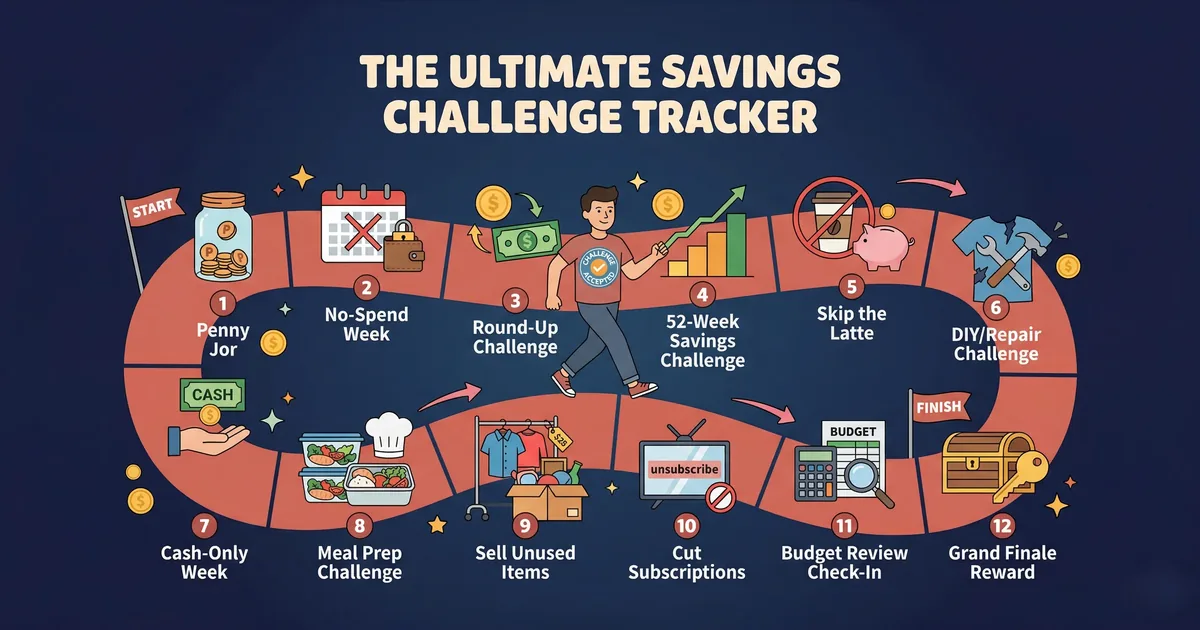
Saving money is easier when it feels like a game. Money saving challenges add structure, accountability, and even fun to building your savings. Here are 12 challenges — from beginner-friendly to aggressive — that can help you save hundreds or thousands this year.
Why Savings Challenges Work
Traditional savings advice says “pay yourself first,” but without a clear plan, most people lose motivation. Challenges work because they:
- Set clear targets: You know exactly how much to save each week or month
- Build incrementally: Small amounts snowball into large sums
- Create accountability: Tracking progress feels rewarding
- Gamify the process: Turning saving into a game makes it feel rewarding
12 Savings Challenges
1. The 52-Week Challenge ($1,378/year)
Save $1 in week 1, $2 in week 2, up to $52 in week 52. Total: $1,378. Start in January and end the year with a nice savings cushion.
2. The $5 Challenge (Varies)
Every time you receive a $5 bill (or make a $5 transfer), stash it away. Most people save $500–$1,000 per year without noticing it.
3. No-Spend Challenge ($500–$1,500/month)
Commit to zero non-essential spending for a full month. Pay only for bills, groceries, and necessities. This is the most aggressive short-term challenge and reveals just how much you spend on wants.
4. Round-Up Challenge ($300–$600/year)
Round every purchase up to the nearest dollar and save the difference. A $3.25 coffee saves $0.75. Over hundreds of transactions per year, it adds up fast.
5. The 100-Envelope Challenge ($5,050)
Number 100 envelopes 1–100. Each day, randomly pick one and put that dollar amount in cash inside. After 100 days, you have $5,050. Adjust for lower budgets by using half amounts ($0.50–$50).
6. Pantry Challenge (Saves $200–$400/month)
Commit to eating only what is already in your pantry, fridge, and freezer for 2–4 weeks. Buy only fresh essentials like milk and produce. This clears food waste and slashes your grocery bill.
7. Weather Wednesday Challenge (Varies)
Every Wednesday, save the amount that matches the high temperature for your city. If it is 72°F, save $7.20. Over a year, this yields roughly $1,500–$2,500 depending on climate.
8. Spare Change Digital Jar ($200–$500/year)
Transfer all spare change from your checking account to savings every Sunday night. If your balance is $1,247.63, transfer $0.63. Small amounts, zero lifestyle impact.
9. Cancel-and-Save Challenge ($50–$300/month)
Each month, cancel one subscription or recurring expense. Redirect that exact amount to savings automatically. By month 6, you could be saving $150+/month from services you do not miss.
10. 30-Day Minimalism Game ($465/month)
On day 1, sell or donate 1 item. Day 2, sell 2 items. Day 30, sell 30 items. Sell everything you can — clothes, gadgets, books. Apply all proceeds to savings.
11. Bi-Weekly Savings Bump ($1,300+/year)
If you are paid bi-weekly, you get 26 paychecks. Budget on 24, and save the 2 “extra” paychecks entirely. That is $1,300–$3,000+ depending on income.
12. Matching Challenge (Doubles any total)
Find a savings partner — spouse, friend, or family member — and match each other dollar for dollar. If one person saves $50 this week, the other must too. Accountability plus doubled results.
Challenge Comparison Table
| Challenge | Difficulty | Duration | Potential Savings |
|---|---|---|---|
| 52-Week | Easy | 12 months | $1,378 |
| $5 Bill | Easy | Ongoing | $500–$1,000/yr |
| No-Spend Month | Hard | 1 month | $500–$1,500 |
| Round-Up | Easy | Ongoing | $300–$600/yr |
| 100-Envelope | Medium | 100 days | $5,050 |
| Pantry | Medium | 2–4 weeks | $200–$400 |
| Weather Wednesday | Easy | 12 months | $1,500–$2,500 |
| Spare Change Jar | Easy | Ongoing | $200–$500/yr |
| Cancel-and-Save | Medium | 6–12 months | $600–$3,600/yr |
| 30-Day Minimalism | Hard | 30 days | $200–$1,000+ |
| Bi-Weekly Bump | Easy | 12 months | $1,300–$3,000 |
| Matching | Medium | Ongoing | 2x any total |
Tips for Success
- Automate when possible: Set up automatic transfers that match your challenge schedule
- Track visually: Print a chart and colour in each milestone — visual progress boosts motivation
- Start small: Pick one Easy-rated challenge before stacking multiple
- Use a separate account: Keep challenge savings in a high-yield account you do not touch
- Celebrate milestones: At the halfway mark, reward yourself with something small and free (a movie night, a park walk)
Track Your Challenge
Use Budgeting365 to set savings goals, track your challenge progress, and see your money grow — free and offline.
Download Budgeting365 — FreeFrequently Asked Questions
What is the 52-week money challenge?
Save $1 in week 1, $2 in week 2, up to $52 in week 52 — totaling $1,378 by year end. Reverse it to front-load the harder weeks.
Which challenge saves the most?
The no-spend challenge can save $500–$1,500 in a single month by eliminating all non-essential spending.
Are money saving challenges effective?
Yes. People who set specific savings targets are 42% more likely to reach their goals compared to saving without a plan.
Can I combine multiple challenges?
Absolutely. Stack a 52-week challenge with a no-spend week each month. Just keep combined commitments realistic.
What should I do with the saved money?
Transfer it to a high-yield savings account or direct it toward a specific goal: emergency fund, debt payoff, or investment.