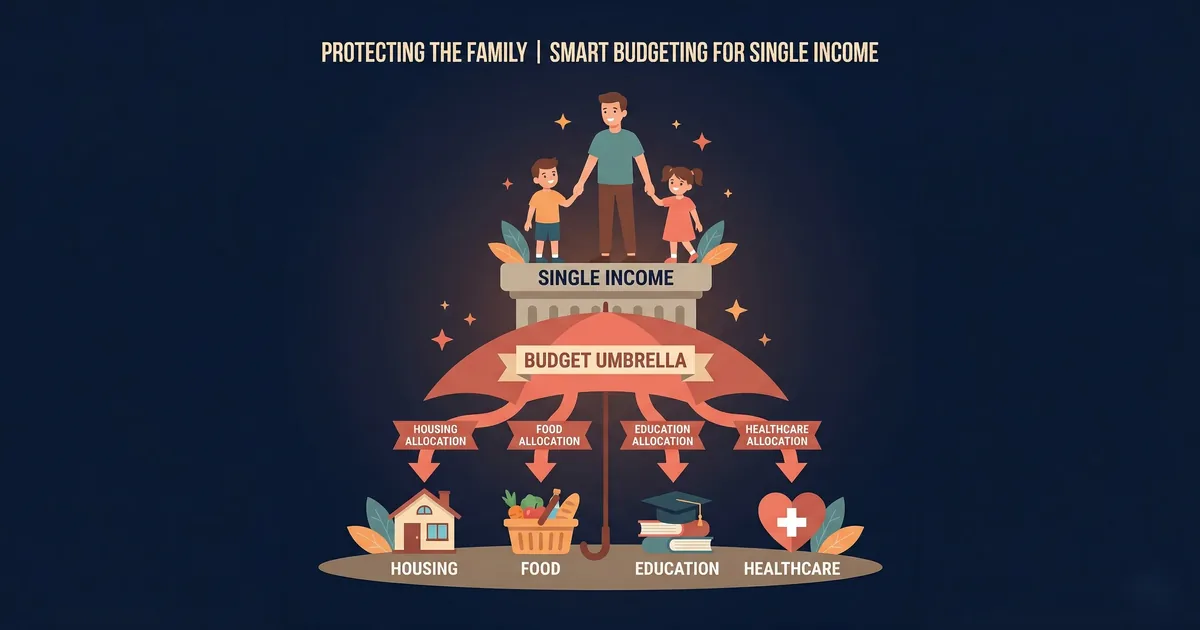
Whether you planned it or not, managing a family on a single income needs careful budgeting. The good news: with the right strategy, you can cover essentials, build savings, and still enjoy life on one salary.
The Single-Income Reality
Single-income budgeting is different from dual-income budgeting in three important ways:
- Zero margin for error: No second paycheck to cover gaps
- Larger emergency fund needed: 6 months minimum vs. the standard 3–6 months
- Insurance is critical: Life and disability insurance protect the sole earner
Single-Income Family Budget Template
Here is a realistic budget for a family of four on $4,500/month net income:
| Category | Amount | % of Income |
|---|---|---|
| Housing (rent/mortgage, insurance, taxes) | $1,250 | 28% |
| Groceries | $600 | 13% |
| Utilities (electric, water, gas, internet) | $300 | 7% |
| Transportation (car payment, gas, insurance) | $450 | 10% |
| Health insurance & medical | $350 | 8% |
| Debt payments | $200 | 4% |
| Savings & emergency fund | $450 | 10% |
| Kids (clothes, activities, school) | $200 | 4% |
| Personal & fun | $250 | 6% |
| Household & miscellaneous | $200 | 4% |
| Life & disability insurance | $150 | 3% |
| Phone plans | $100 | 2% |
| Total | $4,500 | 100% |
Cost-Cutting Strategies That Matter
Housing (Biggest Lever)
- Keep housing under 28% of take-home pay — this is the foundation
- Consider a smaller home, different neighborhood, or refinancing
- House hack: rent a room, basement, or ADU for extra income
Food ($200–$400/mo Savings)
- Meal plan every week — eliminates impulse buys and food waste
- Cook in bulk on Sundays
- Use store brands (30–50% cheaper)
- Shop sales cycles and buy seasonal produce
- Grow a small garden for herbs and vegetables
Transportation ($100–$300/mo Savings)
- One car instead of two when possible
- Buy reliable used vehicles and pay cash
- Batch errands to reduce trips
- Compare insurance annually
Entertainment (Free & Cheap)
- Library for books, movies, events, and programs
- Parks, hiking, picnics — free family activities
- One streaming service at a time (rotate quarterly)
- Community events, free museum days, nature trails
Building Savings on One Income
- Build a $1,000 starter emergency fund as fast as possible
- Pay off consumer debt (credit cards, personal loans)
- Expand emergency fund to 6 months of expenses ($27,000 at $4,500/mo)
- Contribute to retirement — at minimum, capture any employer match
- Start sinking funds for car repairs, holidays, and annual expenses
Earning from Home
The at-home partner can earn money without a full-time job:
| Side Income | Potential Earnings | Flexibility |
|---|---|---|
| Freelance writing/design | $500–$2,000/mo | High |
| Online tutoring | $300–$1,000/mo | High |
| Selling crafts/products | $200–$800/mo | Medium |
| Virtual assistant | $500–$1,500/mo | Medium |
| Babysitting other kids | $400–$1,200/mo | Medium |
Manage Your Family Budget
Budgeting365 helps single-income families track every dollar, set savings goals, and stay organized — all offline, no subscription, AES-256 encrypted.
Download Budgeting365 — FreeFrequently Asked Questions
Can a family really live on one income?
Yes. Millions do. It requires intentional budgeting, low housing costs, minimal debt, and creative cost-cutting.
How much should we save?
Aim for 10% of take-home pay minimum. Prioritize a 6-month emergency fund first.
How does the stay-at-home parent contribute financially?
By eliminating childcare costs ($1,000–$2,000+/mo), cooking at home, managing finances, and potentially freelancing.
What is the biggest challenge?
No financial buffer. A job loss affects 100% of household income, making a 6-month emergency fund critical.
Should we use the 50/30/20 rule?
It’s a starting point, but many single-income families need 60–65% for needs, 15–20% for wants, and 15–20% for savings.