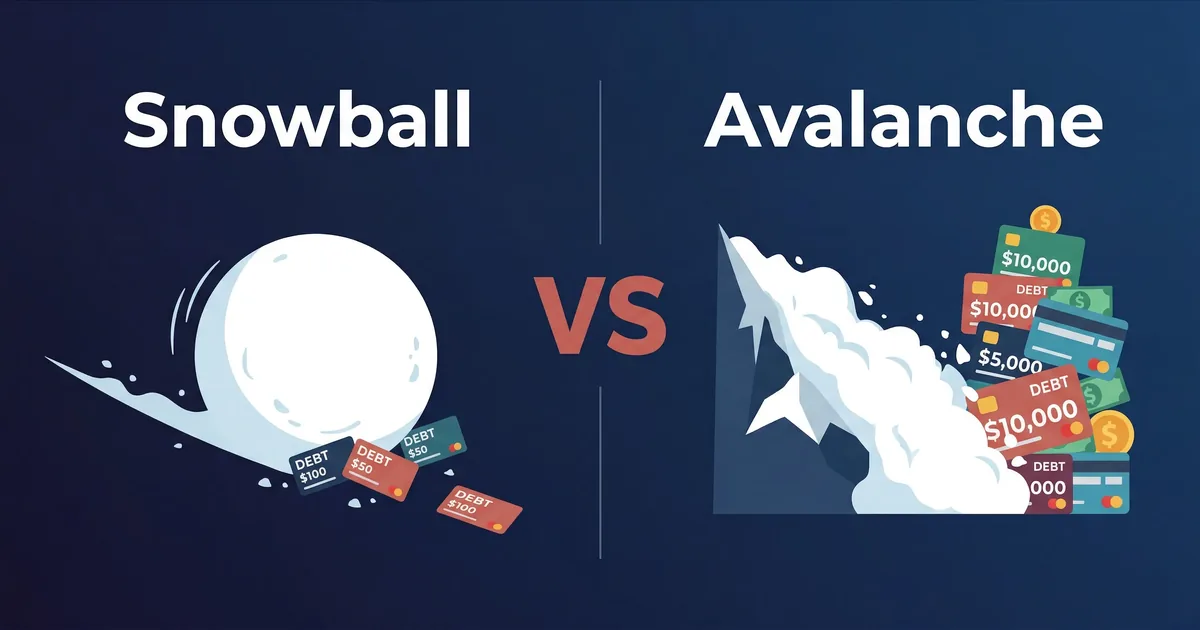
When you have multiple debts, the question is not if you should pay them off — it is in what order. The two most popular strategies are the debt snowball (smallest balance first) and the debt avalanche (highest interest rate first). Both work. The Consumer Financial Protection Bureau (CFPB) says both methods work — the right choice depends on your personality and money situation.
Overview of Both Methods
Both methods start the same way: make minimum payments on all debts, then put every extra dollar toward one specific debt. The difference is which debt gets the extra money first. For a framework to find that extra money, start with creating a monthly budget.
Debt Snowball: Smallest Balance First
How It Works
- List all debts from smallest balance to largest.
- Make minimum payments on everything.
- Put all extra money toward the smallest balance.
- When the smallest debt is paid off, add its payment to the next smallest.
- Repeat until all debts are gone.
Pros
- Quick wins build momentum and motivation, helping you build lasting financial habits.
- Reduces the number of bills faster.
- Higher completion rates according to behavioral research.
- Simple to understand and follow.
Cons
- You may pay more total interest.
- If your smallest debts have low rates, a high-rate large debt keeps building up expensive interest. Understanding how compound interest works against you shows why this matters.
Debt Avalanche: Highest Interest First
How It Works
- List all debts from highest interest rate to lowest.
- Make minimum payments on everything.
- Put all extra money toward the highest-rate debt.
- When it is paid off, redirect its payment to the next highest-rate debt.
- Repeat until all debts are gone.
Pros
- Saves the most money in total interest.
- Mathematically optimal.
- Reaches debt-free status in the fewest total months.
Cons
- If the highest-rate debt is also the largest, progress feels slow early on.
- Requires more patience and discipline.
- Higher dropout rate if motivation fades.
Real-World Example
Imagine you have four debts and $500/month extra to put toward payoff:
| Debt | Balance | APR | Min. Payment |
|---|---|---|---|
| Store Card | $800 | 15% | $25 |
| Credit Card A | $3,200 | 25% | $64 |
| Credit Card B | $5,500 | 18% | $110 |
| Personal Loan | $7,000 | 12% | $155 |
Snowball Order
Store Card ($800) → Credit Card A ($3,200) → Credit Card B ($5,500) → Personal Loan ($7,000). You would clear the store card in about 2 months, giving you an immediate psychological boost.
Avalanche Order
Credit Card A ($3,200/25%) → Credit Card B ($5,500/18%) → Store Card ($800/15%) → Personal Loan ($7,000/12%). The avalanche targets the highest interest rate first, saving the most interest overall — even though it takes longer to get that first payoff win.
Result with $500 extra/month:
| Method | Debt-Free In | Total Interest Paid |
|---|---|---|
| Snowball | 28 months | $2,940 |
| Avalanche | 27 months | $2,610 |
The avalanche saves about $330 and one month in this scenario. The difference grows with larger debts and bigger gaps between interest rates.
Side-by-Side Comparison
| Factor | Debt Snowball | Debt Avalanche |
|---|---|---|
| Payoff order | Smallest balance first | Highest rate first |
| Total interest | Higher | Lower (optimal) |
| Time to debt-free | Slightly longer | Shortest |
| Motivation | High (quick wins) | Requires patience |
| Complexity | Very simple | Slightly more complex |
| Best for | Emotional motivators | Numbers-driven people |
| Dropout risk | Lower | Higher |
How to Choose
Choose the Snowball If:
- You need quick wins to stay motivated.
- You have tried to pay off debt before and quit.
- Your interest rates are similar across debts.
- You have several small debts you can eliminate fast.
Choose the Avalanche If:
- You like working with numbers and are motivated by saving money.
- You have one or two high-interest debts dragging you down.
- You are patient and disciplined about long-term payoff plans.
- The interest rate difference between your debts is large.
The Hybrid Approach
Start with the snowball to pay off one or two easy debts and build confidence. Then switch to the avalanche to save on interest for the remaining larger debts. This gives you the benefits of both methods.
Remember: Both methods beat paying only minimum payments. The worst strategy is spreading extra money evenly across all debts. Pick one method, focus, and commit.
Track Your Debt Payoff
Use Budgeting365 to set up your debt payoff plan, track balances, and watch your progress with visual charts — all free and offline.
Download Budgeting365 — FreeFrequently Asked Questions
What is the debt snowball method?
Pay off debts from smallest balance to largest, rolling each paid-off payment into the next debt. It builds momentum through quick wins.
What is the debt avalanche method?
Pay off debts from highest interest rate to lowest. This saves the most money mathematically but may require more patience early on.
Which method saves more money?
The avalanche always saves more on interest. The difference can range from a few hundred to several thousand dollars depending on your debt balances and rate spreads.
Can I combine both methods?
Yes. Start with snowball to eliminate quick wins, then switch to avalanche for the remaining larger debts. This hybrid approach is very effective.
Does the debt snowball really work?
Research from Harvard Business Review shows snowball leads to higher completion rates. The best method is the one you actually stick with.